#include <frameops.h>
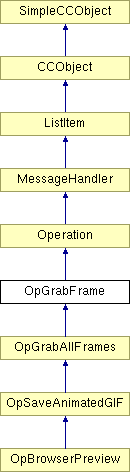
Inheritance diagram for OpGrabFrame:
Public Member Functions | |
| OpGrabFrame () | |
| Constructor. | |
| ~OpGrabFrame () | |
| Destructor. | |
| virtual void | Do (OpDescriptor *pOpDesc) |
| Tries to grab the selected animation frame (i.e. layer). | |
| virtual void | DoWithParam (OpDescriptor *pOpDesc, OpParam *Param) |
| Regenerate the bitmap associated with the active frame layer. | |
Static Public Member Functions | |
| static BOOL | Init () |
| OpGrabFrame initialiser method. | |
| static void | DeInit () |
| De-Initialises OpGrabFrame. | |
| static OpState | GetState (String_256 *, OpDescriptor *) |
| For finding the OpGrabFrame's state. | |
Protected Member Functions | |
| virtual BOOL | StartGrab () |
| Tries to set up useful items prior to doing the grab. | |
| virtual KernelBitmap * | GrabFrame () |
| Tries to grab the currently selected frame/layer into a bitmap. | |
| virtual KernelBitmap * | GrabTheFrame () |
| Tries to grab the currently selected frame/layer into a bitmap. Same as GrabFrame but assumes that the filter to do the grab, m_pBitmapFilter, is already present. | |
| virtual BOOL | EndGrab () |
| Tries to clean up after doing the grab. | |
| virtual BOOL | GetFileNameFromUser () |
| Gives the operation chance to get the filename from the user. In this baseclass version we do nothing as we preview a single frame and so have no need of a filename. | |
| virtual BOOL | PreviewAnimation () |
| Tries to preview the frames that have been grabbed. Uses the stored animation details in m_ExportParams. | |
| virtual BOOL | SaveOrShowTheAnimation (PreviewDialog *pPreviewDialog, BitmapExportParam *pExportParam) |
| Tries to actually do the preview operation required. In this case we just start up the preview dialog box, if not already open, to show the frames that have been grabbed. Uses the stored animation details in m_ExportParams. | |
| BOOL | SetFullBitmapList (BOOL SetFlagState=FALSE) |
| BOOL | SetSingleBitmapInList () |
| BOOL | SetBitmapToListTail () |
| BOOL | CheckIfSingleBitmap (Layer *pLayer, KernelBitmap **ppBitmap) |
| If the Preview Dialog is open and we regenerate a single frame, this function allows us to update our Bitmap list in the Preview Dialog. If the Preview Dialog is open and we regenerate a single frame, this function allows us to add that Bitmap to the head of the preview dialog bitmap list. If the Preview Dialog is open and we regenerate the frames in the animation, this function allows us to update our Bitmap list in the Preview Dialog. For finding out if there is a single bitmap on the layer which is stored in a NodeBitmap at a 1:1 scale and is 8bpp or less and the palette matches the present options. This palette testing is now done after this If it passes all these tests, then set pBitmap to be that bitmap and return True. Also note in the layer that this bitmap can possibly be used to specify this layer. We can only say for sure when we have checked that its palette matches the current animation options. | |
| BOOL | CheckAllForSingleBitmaps (Spread *pSpread, GrabFrameFilter *pBitmapFilter) |
| For going through all the frames and seeing if there is a single bitmap on the frame/layer which is stored in a NodeBitmap at a 1:1 scale and is 8bpp or less and the palette matches the present options. We use the grab frame filter as this is derived off GIF filter and this must already cope with this when loading animations so that it can set the animation options accordingly. | |
| virtual BitmapPreviewData * | GetBitmapPreviewData () |
| virtual BOOL | RememberTheSelection () |
| Tries to remember the current selection state so that we can put it back at the end of the operation. Don't error if it fails as the loss of the selection is no great hardship when memory is tight! | |
| virtual BOOL | PutBackTheSelection () |
| Tries to put back the remembered selection state at the start of the operation. | |
Protected Attributes | |
| SelectionState * | m_pSelState |
| GIFAnimationExportParam | m_ExportParams |
| GrabFrameFilter * | m_pBitmapFilter |
| Document * | m_pDocument |
| Spread * | m_pSpread |
| Layer * | m_pLayer |
| DocView * | m_pView |
| LPLOGPALETTE | m_pBrowserPalette |
Static Protected Attributes | |
| static BitmapPreviewData * | m_pBitmapData = NULL |
Private Member Functions | |
| CC_DECLARE_DYNCREATE (OpGrabFrame) | |
Definition at line 535 of file frameops.h.
|
|
Constructor.
Definition at line 1841 of file frameops.cpp. 01842 { 01843 m_pDocument = NULL; 01844 m_pSpread = NULL; 01845 m_pLayer = NULL; 01846 m_pView = NULL; 01847 01848 m_pBitmapFilter = NULL; 01849 m_pSelState = NULL; 01850 01851 //m_pBitmapData = NULL; 01852 01853 m_pBrowserPalette = NULL; 01854 }
|
|
|
Destructor.
Definition at line 1866 of file frameops.cpp. 01867 { 01868 if (m_pBitmapFilter != NULL) 01869 { 01870 delete m_pBitmapFilter; 01871 m_pBitmapFilter = NULL; 01872 } 01873 01874 if (m_pSelState != NULL) 01875 { 01876 delete m_pSelState; 01877 m_pSelState = NULL; 01878 } 01879 01880 /* if (m_pBitmapData != NULL) 01881 { 01882 delete m_pBitmapData; 01883 m_pBitmapData = NULL; 01884 } */ 01885 01886 if (m_pBrowserPalette != NULL) 01887 { 01888 CCFree(m_pBrowserPalette); 01889 m_pBrowserPalette = NULL; 01890 } 01891 }
|
|
|
|
|
||||||||||||
|
For going through all the frames and seeing if there is a single bitmap on the frame/layer which is stored in a NodeBitmap at a 1:1 scale and is 8bpp or less and the palette matches the present options. We use the grab frame filter as this is derived off GIF filter and this must already cope with this when loading animations so that it can set the animation options accordingly.
Definition at line 2851 of file frameops.cpp. 02852 { 02853 ERROR2IF(pSpread == NULL, FALSE,"CheckIfSingleBitmap bad Spread pointer"); 02854 ERROR2IF(pBitmapFilter == NULL, FALSE,"CheckIfSingleBitmap bad GrabFrameFilter pointer"); 02855 02856 // So we can do the optimised palette case, we must go though all the 02857 // layers/frames and see if there is a single bitmap present. We don't worry 02858 // about the palette on this first pass. We just set up the referenced bitmap 02859 // to be the single bitmap if it passes all the tests. 02860 KernelBitmap * pBitmap = NULL; 02861 BOOL Found = FALSE; 02862 BOOL SolidSet = FALSE; 02863 BOOL OverlaySet = FALSE; 02864 BOOL OverlayedBitmapSet = FALSE; 02865 Layer* pCurrentLayer = pSpread->FindFirstFrameLayer(); 02866 Layer* pNextLayer = NULL; 02867 Layer* pPrevFrameLayer = NULL; 02868 while (pCurrentLayer != NULL) 02869 { 02870 // Move to the next bitmap in the animation 02871 pNextLayer = pCurrentLayer->FindNextFrameLayer(); 02872 02873 // This is just as a double check 02874 if (pCurrentLayer->IsPseudoFrame()) 02875 { 02876 Found = CheckIfSingleBitmap(pCurrentLayer, &pBitmap); 02877 // If the solid flag is set on anything but the last layer then note this 02878 // as dangerous 02879 if (pCurrentLayer->IsSolid() && pNextLayer != NULL) 02880 SolidSet = TRUE; 02881 if (pCurrentLayer->IsOverlay()) 02882 { 02883 // If overlay is set then we can allow it if the previous bitmap has a restore 02884 // type of overlay as this may be an animation that we have saved out 02885 // and then loaded in. If a diff has happened then overlay will be set. 02886 // We can only ever allow this if the layers consist of all bitmaps as 02887 // otherwise the layer may be overlaying a vector layer and hence be wrong. 02888 KernelBitmap * pPrevBitmap = NULL; 02889 if (pPrevFrameLayer) 02890 pPrevBitmap = pPrevFrameLayer->GetReferencedBitmap(); 02891 // Check that we have a single reuseable bitmap on this layer plus one of the previous 02892 if (pPrevBitmap != NULL && pBitmap != NULL) 02893 { 02894 GIFDisposalMethod restore = pPrevBitmap->GetAnimationRestoreType(); 02895 // Do we include GDM_NONE? Not for now. 02896 if (restore != GDM_LEAVE) 02897 { 02898 // We cannot use the bitmap so set the reference to NULL 02899 pCurrentLayer->SetReferencedBitmap(NULL); 02900 OverlaySet = TRUE; 02901 } 02902 else 02903 OverlayedBitmapSet = TRUE; 02904 } 02905 else if (pPrevFrameLayer != NULL) 02906 { 02907 // If overlay set on the first frame then ignore 02908 // We cannot use the bitmap so set the reference to NULL 02909 pCurrentLayer->SetReferencedBitmap(NULL); 02910 OverlaySet = TRUE; 02911 } 02912 } 02913 } 02914 02915 // Move to the next bitmap in the animation 02916 pPrevFrameLayer = pCurrentLayer; 02917 pCurrentLayer = pNextLayer; 02918 } 02919 02920 // Find out about the palettes that the bitmaps have 02921 // Our filter has a useful function for this 02922 UINT32 ReqNumberOfColours = m_ExportParams.GetNumColsInPalette(); 02923 BOOL SamePalettes = FALSE; 02924 BOOL OurBrowserPalette = FALSE; 02925 BOOL AllHaveBitmaps = FALSE; 02926 BOOL AllWithinCount = FALSE; 02927 UINT32 NumberOfColours = ReqNumberOfColours; 02928 pBitmapFilter->CheckSingleBitmapsOnSpread(pSpread, &SamePalettes, &OurBrowserPalette, &AllHaveBitmaps, 02929 &AllWithinCount, &NumberOfColours); 02930 02931 PALETTE_COLOURS Palette = m_ExportParams.GetPaletteCols(); 02932 WEB_PALETTE WebPalette = m_ExportParams.GetPalette(); 02933 02934 BOOL OptionsOk = FALSE; 02935 // If OverlaySet is true then we have found an overlay situation which we cannot cope with and 02936 // so will have set the referenced bitmap to null. 02937 if (OverlaySet && AllHaveBitmaps) 02938 AllHaveBitmaps = FALSE; 02939 02940 // If solid is set on any of the frames then it is too dangerous to reuse any single bitmaps 02941 // We can only allow overlay, if all layers are single bitmaps and the bitmap concerned is 02942 // of type GDM_LEAVE. Otherwise, it is too dangerous. 02943 BOOL BitmapOverlayOk = TRUE; 02944 if (OverlayedBitmapSet && !AllHaveBitmaps) 02945 BitmapOverlayOk = FALSE; 02946 02947 if (!SolidSet && BitmapOverlayOk) 02948 { 02949 // Check from the most fussy option to the least fussy option 02950 if (Palette == PALCOL_BROWSER && WebPalette == PAL_GLOBAL && OurBrowserPalette) 02951 { 02952 OptionsOk = TRUE; 02953 //TRACEUSER( "Neville", _T("Global browser, palettes ok\n")); 02954 } 02955 else if (Palette == PALCOL_OPTIMIZED && WebPalette == PAL_GLOBAL && SamePalettes && AllHaveBitmaps && 02956 NumberOfColours <= ReqNumberOfColours) 02957 { 02958 OptionsOk = TRUE; 02959 //TRACEUSER( "Neville", _T("Global opt, palettes ok\n")); 02960 // Force the global optimised palette to be null for now 02961 pBitmapFilter->SetGlobalOptimisedPalette(NULL); 02962 } 02963 else if (Palette == PALCOL_OPTIMIZED && WebPalette == PAL_LOCAL && AllWithinCount) 02964 { 02965 // Saving local palette so any palette ok but must be within the count 02966 OptionsOk = TRUE; 02967 //TRACEUSER( "Neville", _T("Local Opt, palettes ok\n")); 02968 } 02969 } 02970 02971 // Now we need to go through the layers again and ratify our check 02972 pCurrentLayer = pSpread->FindFirstFrameLayer(); 02973 pBitmap = NULL; 02974 while (pCurrentLayer != NULL) 02975 { 02976 // This is just as a double check 02977 if (pCurrentLayer->IsPseudoFrame()) 02978 { 02979 pBitmap = pCurrentLayer->GetReferencedBitmap(); 02980 if (OptionsOk && pBitmap) 02981 { 02982 // We can use the bitmap instead of generating one 02983 // So make sure that the generated bitmap is clean out 02984 pCurrentLayer->SetGeneratedBitmap(NULL); 02985 // And ensure that the bitmap has the layer's delay 02986 pBitmap->SetDelay(pCurrentLayer->GetFrameDelay()); 02987 02988 // If we are in 02989 if (Palette == PALCOL_OPTIMIZED && WebPalette == PAL_GLOBAL) 02990 { 02991 // If we haven't set up the global optimised palette then do so now 02992 // Pull it from the first bitmap that we find 02993 LPLOGPALETTE pOptPal = pBitmapFilter->GetGlobalOptimisedPalette(); 02994 if (pOptPal == NULL) 02995 { 02996 pOptPal = DIBUtil::CopyBitmapPaletteIntoLogPalette(pBitmap); 02997 // Something went a bit wrong 02998 if (pOptPal == NULL) 02999 return FALSE; 03000 pBitmapFilter->SetGlobalOptimisedPalette(pOptPal); 03001 } 03002 } 03003 } 03004 else 03005 { 03006 // We cannot use the bitmap so set the reference to NULL 03007 pCurrentLayer->SetReferencedBitmap(NULL); 03008 } 03009 } 03010 03011 // Move to the next bitmap in the animation 03012 pCurrentLayer = pCurrentLayer->FindNextFrameLayer(); 03013 } 03014 03015 return TRUE; 03016 }
|
|
||||||||||||
|
If the Preview Dialog is open and we regenerate a single frame, this function allows us to update our Bitmap list in the Preview Dialog. If the Preview Dialog is open and we regenerate a single frame, this function allows us to add that Bitmap to the head of the preview dialog bitmap list. If the Preview Dialog is open and we regenerate the frames in the animation, this function allows us to update our Bitmap list in the Preview Dialog. For finding out if there is a single bitmap on the layer which is stored in a NodeBitmap at a 1:1 scale and is 8bpp or less and the palette matches the present options. This palette testing is now done after this If it passes all these tests, then set pBitmap to be that bitmap and return True. Also note in the layer that this bitmap can possibly be used to specify this layer. We can only say for sure when we have checked that its palette matches the current animation options.
Definition at line 2637 of file frameops.cpp. 02638 { 02639 ERROR2IF(pLayer == NULL, FALSE,"CheckIfSingleBitmap bad layer pointer"); 02640 ERROR2IF(ppBitmap == NULL, FALSE,"CheckIfSingleBitmap bad bitmap pointer"); 02641 02642 // Get some of the current export options 02643 DocRect BoundingRect = m_ExportParams.GetAnimationBoundingRect(); 02644 ERROR3IF(BoundingRect.IsEmpty(),"Bounding rect not set up"); 02645 // PALETTE_COLOURS Palette = m_ExportParams.GetPaletteCols(); 02646 // WEB_PALETTE WebPalette = m_ExportParams.GetPalette(); 02647 02648 KernelBitmap * pBitmap = NULL; 02649 BOOL Scaled1to1 = FALSE; 02650 BOOL PaletteOk = FALSE; 02651 BOOL InsideBoundingRect = TRUE; 02652 BOOL FullFirstFrame = TRUE; 02653 UINT32 Bpp = 0; 02654 INT32 NodeCount = 0; 02655 NodeBitmap *pNodeBmp = NULL; 02656 02657 // check if we are the first animation frame, if so then we the bitmap must be the same 02658 // size as the animation bounding rect. Otherwise, the first frame will not be the size 02659 // of the animation which highlights a bug in MS IE 3.0 02660 Layer * pPreviousFrame = pLayer->FindPrevFrameLayer(); 02661 02662 Node * pNode = pLayer->FindFirstChild(); 02663 while (pNode != NULL) 02664 { 02665 // If the node renders something on the screen then we count it as this will mean that 02666 // the single bitmap does not fully define the layer. 02667 // It ignores attributes, hidden nodes, etc - nodes that don't render anything themselves. 02668 if (pNode->IsBounded()) 02669 NodeCount++; 02670 02671 // We need to note any NodeBitmap nodes 02672 if (pNode->IS_KIND_OF(NodeBitmap) && NodeCount == 1) 02673 { 02674 // Convert the node to a nodebitmap so we can get at the useful NodeBitmap 02675 // related data 02676 pNodeBmp = (NodeBitmap *)pNode; 02677 02678 // Get the size and position of the node bitmap 02679 DocRect rect = pNodeBmp->GetBoundingRect(TRUE, FALSE); 02680 02681 // If we have no previous frame then check that the first frame is the 02682 // size of the animation 02683 if (pPreviousFrame == NULL) 02684 { 02685 DocRect AniBoundingRect = m_ExportParams.GetAnimationBoundingRect(); 02686 ERROR3IF(AniBoundingRect.IsEmpty(),"CheckIfSingleBitmap Animation bounding rect not set up!"); 02687 02688 // REMEMBER account for rounding errors 02689 const INT32 delta = 50; 02690 if ( 02691 (AniBoundingRect.lo.x >= (rect.lo.x - delta)) && (AniBoundingRect.lo.x <= (rect.lo.x + delta)) && 02692 (AniBoundingRect.hi.x >= (rect.hi.x - delta)) && (AniBoundingRect.hi.x <= (rect.hi.x + delta)) && 02693 (AniBoundingRect.lo.y >= (rect.lo.y - delta)) && (AniBoundingRect.lo.y <= (rect.lo.y + delta)) && 02694 (AniBoundingRect.hi.y >= (rect.hi.y - delta)) && (AniBoundingRect.hi.y <= (rect.hi.y + delta)) 02695 ) 02696 { 02697 FullFirstFrame = TRUE; 02698 } 02699 else 02700 { 02701 FullFirstFrame = FALSE; 02702 } 02703 } 02704 02705 // Get the bitmap stored inside the node, if any 02706 pBitmap = pNodeBmp->GetBitmap(); 02707 if (pBitmap) 02708 { 02709 // Get the width/height of the bitmap in millipoints 02710 INT32 BmpWidth = pBitmap->GetRecommendedWidth(); 02711 INT32 BmpHeight = pBitmap->GetRecommendedHeight(); 02712 02713 // Get the Width of the Bitmap in Millipoints 02714 INT32 Width = INT32(pNodeBmp->Parallel[0].Distance(pNodeBmp->Parallel[1])); 02715 INT32 Height = INT32(pNodeBmp->Parallel[1].Distance(pNodeBmp->Parallel[2])); 02716 02717 // REMEMBER account for rounding errors and the orientation being the other 02718 // way round 02719 const INT32 delta = 2; 02720 if ((Width >= BmpWidth - delta && Width <= BmpWidth + delta && 02721 Height >= BmpHeight - delta && Height <= BmpHeight + delta) || 02722 (Height >= BmpWidth - delta && Height <= BmpWidth + delta && 02723 Width >= BmpHeight - delta && Width <= BmpHeight + delta) ) 02724 Scaled1to1 = TRUE; 02725 02726 Bpp = pBitmap->GetBPP(); 02727 02728 // If the bitmap is 8bpp of less then assume this is ok for now 02729 // We will check the palette in a second pass 02730 if (Bpp <= 8) 02731 { 02732 PaletteOk = TRUE; 02733 } 02734 02735 /* // We cannot cope with GLOBAL OPTIMISED palettes at present as we 02736 // would need to wait until the palette was generated before we could 02737 // check. 02738 if (Palette == PALCOL_OPTIMIZED && WebPalette == PAL_LOCAL) 02739 { 02740 // Saving local palette so any palette ok 02741 PaletteOk = TRUE; 02742 } 02743 else if (Palette == PALCOL_BROWSER && WebPalette == PAL_GLOBAL) 02744 { 02745 // Check if we have a browser palette on this bitmap 02746 //PaletteOk = pBitmap->IsBrowserPalette(); 02747 // Old way of testing. Too lenient as all it does it check that the palette 02748 // has the correct colours in it, not that the palette will be the same one 02749 // that we are going to output as the browser palette 02750 02751 // Obviously, browser palettes can only happen on 8bpp bitmaps 02752 if (Bpp == 8) 02753 { 02754 // First of all, if we haven't already got our palette that we check against 02755 // then construct it. 02756 if (m_pBrowserPalette == NULL) 02757 { 02758 UINT32 PaletteSize = UINT32(pow(2,Bpp)); 02759 m_pBrowserPalette = DIBUtil::AllocateLogPalette(PaletteSize); 02760 if (m_pBrowserPalette != NULL) 02761 { 02762 // Now force it into a browser compatible state 02763 BOOL AvoidSystemColours = TRUE; 02764 PaletteManager::MakePaletteBrowserCompatible(m_pBrowserPalette, AvoidSystemColours); 02765 } 02766 } 02767 02768 INT32 TransColour = -1; 02769 pBitmap->GetTransparencyIndex(&TransColour); 02770 02771 if (m_pBrowserPalette != NULL) 02772 { 02773 PaletteOk = pBitmap->ArePalettesTheSame(m_pBrowserPalette, TransColour); 02774 } 02775 else 02776 { 02777 ERROR3("Couldn't allocate browser palette"); 02778 PaletteOk = FALSE; 02779 } 02780 } 02781 else 02782 PaletteOk = FALSE; 02783 } 02784 } */ 02785 02786 if (Scaled1to1 && PaletteOk && !rect.IsEmpty() && !BoundingRect.IsEmpty()) 02787 { 02788 // Work out the position of the bitmap relative to the top left hand 02789 // corner of the bounding rectangle in terms of pixels and put this 02790 // in the bitmap 02791 MILLIPOINT LeftOffsetMP = rect.lo.x - BoundingRect.lo.x; 02792 MILLIPOINT TopOffsetMP = BoundingRect.hi.y - rect.hi.y; 02793 if (LeftOffsetMP >= 0 && TopOffsetMP >= 0) 02794 { 02795 const UINT32 dpi = 96; 02796 UINT32 LeftOffset = LeftOffsetMP * dpi/72000; 02797 UINT32 TopOffset = TopOffsetMP * dpi/72000; 02798 02799 pBitmap->SetLeftOffset(LeftOffset); 02800 pBitmap->SetTopOffset(TopOffset); 02801 InsideBoundingRect = TRUE; 02802 } 02803 } 02804 } 02805 } 02806 02807 pNode = pNode->FindNext(); 02808 } 02809 02810 // If all these checks are TRUE then return the bitmap as the source of the frame 02811 if (pBitmap != NULL && Scaled1to1 && Bpp <= 8 && NodeCount == 1 && 02812 PaletteOk && InsideBoundingRect && FullFirstFrame) 02813 { 02814 if (ppBitmap) 02815 *ppBitmap = pBitmap; 02816 02817 // Make the layer remember this bitmap 02818 // Remember this bitmap as the reference one 02819 pLayer->SetReferencedBitmap(pBitmap); 02820 02821 //TRACEUSER( "Neville", _T("Using single bitmap\n")); 02822 02823 return TRUE; 02824 } 02825 02826 // Ensure that we have no reference saved 02827 pLayer->SetReferencedBitmap(NULL); 02828 02829 return FALSE; 02830 }
|
|
|
De-Initialises OpGrabFrame.
Definition at line 1571 of file frameops.cpp. 01572 { 01573 // Deinit our static preview bitmap data pointer if allocated 01574 // This should clean up any temp files that we have used 01575 if (m_pBitmapData != NULL) 01576 { 01577 delete m_pBitmapData; 01578 m_pBitmapData = NULL; 01579 } 01580 01581 // Give the browser preview chance to clean up its temp file useage 01582 OpBrowserPreview::RemoveTempFile(); 01583 }
|
|
|
Tries to grab the selected animation frame (i.e. layer).
Reimplemented from Operation. Reimplemented in OpGrabAllFrames. Definition at line 1914 of file frameops.cpp. 01915 { 01916 DoWithParam(pOpDesc, NULL); 01917 return; 01918 }
|
|
||||||||||||
|
Regenerate the bitmap associated with the active frame layer.
Reimplemented from Operation. Definition at line 1936 of file frameops.cpp. 01937 { 01938 // ERROR3IF(pParam == NULL, "OpGrabFrame::DoWithParam - NULL Param passed in"); 01939 01940 // Get useful data and set up items before starting the grab process 01941 if (!StartGrab()) 01942 { 01943 // We failed to grab the frame 01944 FailAndExecute(); 01945 End(); 01946 return; 01947 } 01948 01949 // If a parameter has been supplied then this should be a layer pointer, which we 01950 // should then use to grab the frame 01951 // Otherwise, we assume we must grab the active frame (StartGrab sets m_pLayer to the active layer) 01952 if (pParam != NULL) 01953 { 01954 // recover the layer pointer that has been specified 01955 Layer* pLayer = (Layer *) (void *) pParam->Param1; 01956 if (pLayer) 01957 { 01958 ERROR3IF(!pLayer->IS_KIND_OF(Layer), "OpParam passed is not a Layer"); 01959 01960 // Note the layer we are expected to grab in our class variable 01961 m_pLayer = pLayer; 01962 01963 // Set up the visibility of the other layers using this layer 01964 // as the new temporary and acting active layer 01965 FrameSGallery::FixOtherLayersFromActive(m_pLayer); 01966 } 01967 } 01968 01969 // Are we trying to grab a hidden frame? 01970 if (m_pLayer->IsHiddenFrame()) 01971 { 01972 // yes, tell the user 01973 InformError(_R(IDS_FRAMEISHIDDEN)); 01974 //ERROR3IF(m_pLayer->IsHiddenFrame(),"OpGrabFrame::DoWithParam Frame is hidden"); 01975 // and then fail 01976 FailAndExecute(); 01977 End(); 01978 return; 01979 } 01980 01981 // If required, allow the op to get a filename from the user. 01982 // This also allows them access to the options via the button on the save dialog box. 01983 // This is why we must do this first rather than after we have generated the frames. 01984 if (!GetFileNameFromUser()) 01985 { 01986 // We failed to grab the frame 01987 FailAndExecute(); 01988 End(); 01989 return; 01990 } 01991 01992 // Get our static pointer to the Preview Dialog. 01993 PreviewDialog* pPreviewDlg = PreviewDialog::GetPreviewDialog(); 01994 // If the preview dialog is already open, find the selected frame layer. 01995 if (pPreviewDlg) 01996 pPreviewDlg->StopPreviewing(); 01997 01998 // Go and do the work to grab the frame 01999 KernelBitmap* pBitmap = GrabFrame(); 02000 if (pBitmap == NULL) 02001 { 02002 // We failed to grab the frame. 02003 // Try and put back the selection that we recorded at the start 02004 PutBackTheSelection(); 02005 FailAndExecute(); 02006 End(); 02007 return; 02008 } 02009 02010 // If we have grabbed the non-active layer then make sure the active layer 02011 // is set up as current 02012 Layer *pActiveLayer = m_pSpread->FindActiveLayer(); 02013 if (pActiveLayer && m_pLayer != pActiveLayer) 02014 FrameSGallery::FixOtherLayersFromActive(pActiveLayer); 02015 02016 // Clean up after the grabbing process. 02017 if (!EndGrab()) 02018 { 02019 // We failed to clean up after grabbing the frame. 02020 FailAndExecute(); 02021 End(); 02022 return; 02023 } 02024 02025 // Add this bitmap and layer pairing to our export list 02026 if (!m_ExportParams.AddLayerAndBitmap(m_pLayer, pBitmap)) 02027 { 02028 FailAndExecute(); 02029 End(); 02030 return; 02031 } 02032 02033 // Open the preview dialog, and display the selected frame. 02034 if(!PreviewAnimation()) 02035 { 02036 // We failed to preview the bitmap 02037 FailAndExecute(); 02038 End(); 02039 return; 02040 } 02041 02042 // Finish the operation 02043 End(); 02044 02045 return; 02046 }
|
|
|
Tries to clean up after doing the grab.
Definition at line 2376 of file frameops.cpp. 02377 { 02378 // Try and put back the selection that we recorded at the start 02379 PutBackTheSelection(); 02380 02381 // Make sure that the new selection is up to date 02382 //Range * pSelRange = GetApplication()->FindSelection(); 02383 /* if (pSelRange == NULL || !DoInvalidateNodesRegions(*pSelRange, TRUE)) 02384 { 02385 // We failed to invalidate the region 02386 return FALSE; 02387 } */ 02388 02389 /* // Recover the active layer again and make sure that it is being shown correctly. 02390 ERROR2IF(m_pSpread == NULL,FALSE,"bad spread in EndGrab()"); 02391 Layer *pLayer = m_pSpread->FindActiveLayer(); 02392 ERROR2IF(pLayer == NULL,"No active layer in EndGrab()") 02393 if (pLayer) 02394 { 02395 FrameSGallery::FixOtherLayersFromActive(pLayer); 02396 } */ 02397 02398 return TRUE; 02399 }
|
|
|
Definition at line 572 of file frameops.h. 00572 { return m_pBitmapData; }
|
|
|
Gives the operation chance to get the filename from the user. In this baseclass version we do nothing as we preview a single frame and so have no need of a filename.
Reimplemented in OpSaveAnimatedGIF, and OpBrowserPreview. Definition at line 2414 of file frameops.cpp. 02415 { 02416 // Baseclass version, do nothing 02417 return TRUE; 02418 }
|
|
||||||||||||
|
For finding the OpGrabFrame's state.
Reimplemented in OpSaveAnimatedGIF. Definition at line 1600 of file frameops.cpp. 01601 { 01602 01603 //The frame movement controls on the GIF animation bar now work on frames only. 01604 OpState OpSt; 01605 01606 #ifdef WEBSTER 01607 String_256 DisableReason; 01608 01609 // Is there a selected spread? 01610 Spread * pSpread = Document::GetSelectedSpread(); 01611 if (pSpread) 01612 { 01613 // yes, so check if there is an active layer 01614 Layer * pLayer = pSpread->FindActiveLayer(); 01615 if (pLayer) 01616 { 01617 // Ensure that we have some visible objects on the specified layer to render 01618 // Could use a range but easier just to check if there are visible objects on the page 01619 DocRect VisibleRect = pSpread->GetPageVisibleBounds(); 01620 BOOL Empty = VisibleRect.IsEmpty(); 01621 // If this frame has nothing visible on it then check if there are renderable objects 01622 // on any other frames in the animation. 01623 if (Empty) 01624 { 01625 // Cannot assume that all the frame layers are actually frame layers so 01626 // go through all those that might be frame layers. 01627 Layer * pFrame = pSpread->FindFirstLayer(); 01628 while (pFrame && Empty) 01629 { 01630 if (pFrame->IsPseudoFrame() && pFrame->HasLayerGotRenderableChildren()) 01631 Empty = FALSE; 01632 pFrame = pFrame->FindNextLayer(); 01633 } 01634 } 01635 if (pOpDesc && pOpDesc->Token != String(OPTOKEN_FRAME_GRABFRAME) && !Empty) 01636 { 01637 // Cannot assume that all the frame layers are actually frame layers so 01638 // go through all those that might be frame layers. 01639 Layer * pFrame = pSpread->FindFirstLayer(); 01640 BOOL AllHidden = TRUE; 01641 while (pFrame && AllHidden) 01642 { 01643 if (pFrame->IsPseudoFrame() && !pFrame->IsHiddenFrame()) 01644 AllHidden = FALSE; 01645 pFrame = pFrame->FindNextLayer(); 01646 } 01647 if (AllHidden) 01648 { 01649 OpSt.Greyed = TRUE; 01650 // Load reason why operation is disabled 01651 DisableReason = String_256(_R(IDS_ALLFRAMESAREHIDDEN)); 01652 if (pUIDescription) 01653 *pUIDescription = DisableReason; 01654 } 01655 else 01656 { 01657 // Yes, so we are allowed to grab the frame or all the frames 01658 OpSt.Greyed = FALSE; 01659 } 01660 } 01661 else if (pOpDesc && pOpDesc->Token == String(OPTOKEN_FRAME_GRABFRAME) && pLayer->IsHiddenFrame()) 01662 { 01663 // If we are the grab frame op then check that the current layer is not 01664 // hidden. If so then disallow 01665 OpSt.Greyed = TRUE; 01666 // Load reason why operation is disabled 01667 DisableReason = String_256(_R(IDS_FRAMEISHIDDEN)); 01668 if (pUIDescription) 01669 *pUIDescription = DisableReason; 01670 } 01671 else if (!Empty) 01672 { 01673 // Yes, so we are allowed to grab the frame or all the frames 01674 OpSt.Greyed = FALSE; 01675 } 01676 else 01677 { 01678 OpSt.Greyed = TRUE; 01679 // Load reason why operation is disabled 01680 DisableReason = String_256(_R(IDS_NO_VISIBLE_OBJECTS)); 01681 if (pUIDescription) 01682 *pUIDescription = DisableReason; 01683 } 01684 } 01685 else 01686 { 01687 // No, so we are greyed 01688 OpSt.Greyed = TRUE; 01689 } 01690 } 01691 else 01692 { 01693 // No selected spread, so we are greyed 01694 OpSt.Greyed = TRUE; 01695 01696 // Load reason why operation is disabled 01697 DisableReason = String_256(_R(IDS_NO_DOC)); 01698 if (pUIDescription) 01699 *pUIDescription = DisableReason; 01700 } 01701 01702 #else 01703 // Flag to determine the document mode. 01704 BOOL FrameMode = FALSE; 01705 01706 // Get a ptr to the selected spread 01707 Spread* pSpread = Document::GetSelectedSpread(); 01708 01709 // Ensure a valid spread ptr. 01710 if(pSpread) 01711 { 01712 // Are there any frame layers? 01713 Layer* pFrameLayer = pSpread->FindFirstFrameLayer(); 01714 01715 //If a frame layer exists, then this is an animation doc. 01716 if (pFrameLayer) 01717 FrameMode = TRUE; 01718 } 01719 01720 if(FrameMode) 01721 { 01722 String_256 DisableReason; 01723 01724 if (pSpread) 01725 { 01726 // yes, so check if there is an active layer 01727 Layer * pLayer = pSpread->FindActiveLayer(); 01728 01729 if (pLayer) 01730 { 01731 // Ensure that we have some visible objects on the specified layer to render 01732 // Could use a range but easier just to check if there are visible objects on the page 01733 DocRect VisibleRect = pSpread->GetPageVisibleBounds(); 01734 BOOL Empty = VisibleRect.IsEmpty(); 01735 // If this frame has nothing visible on it then check if there are renderable objects 01736 // on any other frames in the animation. 01737 if (Empty) 01738 { 01739 // Cannot assume that all the frame layers are actually frame layers so 01740 // go through all those that might be frame layers. 01741 Layer * pFrame = pSpread->FindFirstLayer(); 01742 while (pFrame && Empty) 01743 { 01744 if (pFrame->IsPseudoFrame() && pFrame->HasLayerGotRenderableChildren()) 01745 Empty = FALSE; 01746 01747 pFrame = pFrame->FindNextLayer(); 01748 } 01749 } 01750 01751 if (pOpDesc && pOpDesc->Token != String(OPTOKEN_FRAME_GRABFRAME) && !Empty) 01752 { 01753 // Cannot assume that all the frame layers are actually frame layers so 01754 // go through all those that might be frame layers. 01755 Layer * pFrame = pSpread->FindFirstLayer(); 01756 BOOL AllHidden = TRUE; 01757 while (pFrame && AllHidden) 01758 { 01759 if (pFrame->IsPseudoFrame() && !pFrame->IsHiddenFrame()) 01760 AllHidden = FALSE; 01761 01762 pFrame = pFrame->FindNextLayer(); 01763 } 01764 01765 if (AllHidden) 01766 { 01767 OpSt.Greyed = TRUE; 01768 // Load reason why operation is disabled 01769 DisableReason = String_256(_R(IDS_ALLFRAMESAREHIDDEN)); 01770 if (pUIDescription) 01771 *pUIDescription = DisableReason; 01772 } 01773 else 01774 { 01775 // Yes, so we are allowed to grab the frame or all the frames 01776 OpSt.Greyed = FALSE; 01777 } 01778 } 01779 else if (pOpDesc && pOpDesc->Token == String(OPTOKEN_FRAME_GRABFRAME) && pLayer->IsHiddenFrame()) 01780 { 01781 // If we are the grab frame op then check that the current layer is not 01782 // hidden. If so then disallow 01783 OpSt.Greyed = TRUE; 01784 // Load reason why operation is disabled 01785 DisableReason = String_256(_R(IDS_FRAMEISHIDDEN)); 01786 if (pUIDescription) 01787 *pUIDescription = DisableReason; 01788 } 01789 else if (!Empty) 01790 { 01791 // Yes, so we are allowed to grab the frame or all the frames 01792 OpSt.Greyed = FALSE; 01793 } 01794 else 01795 { 01796 OpSt.Greyed = TRUE; 01797 // Load reason why operation is disabled 01798 DisableReason = String_256(_R(IDS_NO_VISIBLE_OBJECTS)); 01799 if (pUIDescription) 01800 *pUIDescription = DisableReason; 01801 } 01802 } 01803 else 01804 { 01805 // No, so we are greyed 01806 OpSt.Greyed = TRUE; 01807 } 01808 } 01809 else 01810 { 01811 // No selected spread, so we are greyed 01812 OpSt.Greyed = TRUE; 01813 01814 // Load reason why operation is disabled 01815 DisableReason = String_256(_R(IDS_NO_DOC)); 01816 if (pUIDescription) 01817 *pUIDescription = DisableReason; 01818 } 01819 } 01820 else 01821 { 01822 // The document is layer based, so we are greyed. 01823 OpSt.Greyed = TRUE; 01824 *pUIDescription = String_256 (_R(IDS_NO_FRAMES)); 01825 } 01826 #endif 01827 01828 return OpSt; 01829 }
|
|
|
Tries to grab the currently selected frame/layer into a bitmap.
Definition at line 2204 of file frameops.cpp. 02205 { 02206 ERROR2IF(m_pDocument == NULL,FALSE,"GrabFrame bad document pointer"); 02207 ERROR2IF(m_pSpread == NULL,FALSE,"GrabFrame bad spread pointer"); 02208 ERROR2IF(m_pLayer == NULL,FALSE,"GrabFrame bad layer pointer"); 02209 ERROR2IF(m_pView == NULL,FALSE,"GrabFrame bad view pointer"); 02210 02211 // Create a special Bitmap filter, that creates a bitmap 02212 // and puts it in the tree 02213 ERROR3IF(m_pBitmapFilter != NULL,"Already have a pBitmapFilter!"); 02214 m_pBitmapFilter = new GrabFrameFilter(); 02215 if (m_pBitmapFilter == NULL) 02216 { 02217 return NULL; 02218 } 02219 02220 // Get the filter to work out the new rectangle 02221 m_pBitmapFilter->SetUpClippingRectangleForExport(m_pSpread, DRAWING); 02222 DocRect NewBoundingRect = m_pBitmapFilter->GetClipRect(); 02223 // Save away the new bounding rectangle 02224 m_pSpread->SetAnimationBoundingRect(NewBoundingRect); 02225 m_ExportParams.SetAnimationBoundingRect(NewBoundingRect); 02226 02227 // Save away the quality that this was grabbed at 02228 Quality NewQuality = m_pView->RenderQuality; 02229 m_pSpread->SetAnimationQuality(NewQuality); 02230 02231 // Check all the layers to see if they contain a single bitmap which we can use 02232 // instead of generating one. 02233 // This will mark all valid single bitmaps using the reference in the layer 02234 if (!CheckAllForSingleBitmaps(m_pSpread, m_pBitmapFilter)) 02235 { 02236 delete m_pBitmapFilter; 02237 m_pBitmapFilter = NULL; 02238 return NULL; 02239 } 02240 02241 // Check if we are grabbing a changed background layer frame, if it is then 02242 // we will then clear the edited bit on this. Once this happens then if the 02243 // user grabs all frames then the dependent frames wont be updated. 02244 if (m_pLayer->IsEdited() && m_pLayer->IsSolid()) 02245 { 02246 // Mark all frames above this as edited until we reach the last frame 02247 // OR we hit a solid/background layer. 02248 Layer * pFrame = m_pLayer->FindNextFrameLayer(); 02249 while (pFrame != NULL && !pFrame->IsSolid()) 02250 { 02251 // Mark that frame as edited 02252 pFrame->SetEdited(TRUE); 02253 pFrame = pFrame->FindNextFrameLayer(); 02254 } 02255 } 02256 02257 // Check to see if we have a single bitmap on the layer which is stored 02258 // in a NodeBitmap at a 1:1 scale and is 8bpp or less and the palette matches 02259 // the present options. 02260 // If it passes all these tests, then set pBitmapToCreate to be that bitmap. 02261 // Otherwise, we will need to go and convert the current frame into a bitmap 02262 KernelBitmap* pBitmapToCreate = NULL; 02263 //if (!CheckIfSingleBitmap(m_pLayer, &pBitmapToCreate)) 02264 // If there is a referenced bitmap then we can use this instead of generating one 02265 pBitmapToCreate = m_pLayer->GetReferencedBitmap(); 02266 if (pBitmapToCreate == NULL) 02267 { 02268 // Grab the frame 02269 02270 02271 // As this will affect us during grabbing, we should force it into the known 02272 // non-interferring state 02273 BOOL CurrentVisEdState = Layer::ActiveLayerVisibleAndEditable; 02274 Layer::ActiveLayerVisibleAndEditable = FALSE; 02275 // The all visible flag will also do this for us. 02276 Document* pDoc = m_pSpread->FindParentDocument(); 02277 BOOL CurrentAllVisibleState = FALSE; 02278 if (pDoc != NULL) 02279 { 02280 CurrentAllVisibleState = pDoc->IsAllVisible(); 02281 pDoc->SetAllVisible(FALSE); 02282 } 02283 02284 // Go and convert the frame into its bitmap form 02285 pBitmapToCreate = GrabTheFrame(); 02286 02287 // Put back the active layer's visibilty and selection 02288 Layer::ActiveLayerVisibleAndEditable = CurrentVisEdState; 02289 // Put back the all visible state 02290 if (pDoc != NULL) 02291 pDoc->SetAllVisible(CurrentAllVisibleState); 02292 } 02293 02294 // Note the capture quality that the frame was captured at but only if we worked correctly 02295 if (pBitmapToCreate) 02296 m_pLayer->SetCaptureQuality(NewQuality); 02297 02298 // remove the filter as we have no more use for it 02299 delete m_pBitmapFilter; 02300 m_pBitmapFilter = NULL; 02301 02302 // Clear the edited flag on the layer 02303 m_pLayer->SetEdited(FALSE); 02304 #ifdef _DEBUG 02305 // Tell the frame gallery to update its display of the frame 02306 BROADCAST_TO_ALL(LayerMsg(m_pLayer, LayerMsg::REDRAW_LAYER)); 02307 #endif 02308 02309 // return the bitmap to the caller 02310 return pBitmapToCreate; 02311 }
|
|
|
Tries to grab the currently selected frame/layer into a bitmap. Same as GrabFrame but assumes that the filter to do the grab, m_pBitmapFilter, is already present.
Definition at line 2327 of file frameops.cpp. 02328 { 02329 ERROR2IF(m_pDocument == NULL,FALSE,"GrabFrame bad document pointer"); 02330 ERROR2IF(m_pLayer == NULL,FALSE,"GrabFrame bad layer pointer"); 02331 ERROR2IF(m_pBitmapFilter == NULL,FALSE,"GrabFrame m_pBitmapFilter pointer"); 02332 02333 // Tell it about the layer that is being captured 02334 // This supplies the name of the bitmap and the export parameters 02335 m_pBitmapFilter->SetLayerBeingCaptured(m_pLayer); 02336 02337 KernelBitmap* pBitmapToCreate = NULL; 02338 if (!m_pBitmapFilter->DoCreateBitmap(this, m_pDocument, &pBitmapToCreate) || pBitmapToCreate == NULL) 02339 { 02340 return NULL; 02341 } 02342 02343 // Copy across the delay from the layer (Andy 5/1/01) 02344 DWORD delay = m_pLayer->GetFrameDelay(); 02345 pBitmapToCreate->SetDelay(delay); 02346 02347 // Make the layer remember this bitmap as the one that was generated 02348 if (!m_pLayer->SetGeneratedBitmap(pBitmapToCreate)) 02349 { 02350 ERROR3("Couldn't add bitmap to layer!"); 02351 if (pBitmapToCreate) 02352 delete pBitmapToCreate; 02353 return NULL; 02354 } 02355 02356 // DO NOT unset the edited flag. This version is used in GrabAllFrames and we need the 02357 // edited flags present until we have finished grabbing so that we can work out dependent 02358 // layers. 02359 02360 // return the bitmap to the caller 02361 return pBitmapToCreate; 02362 }
|
|
|
OpGrabFrame initialiser method.
Reimplemented from SimpleCCObject. Definition at line 1435 of file frameops.cpp. 01436 { 01437 BOOL ok = FALSE; 01438 01439 // start of non-undoable operations 01440 ok = RegisterOpDescriptor( 01441 0, // Tool ID 01442 _R(IDS_FRAMEPROPERTIES), // String resource ID 01443 CC_RUNTIME_CLASS(OpFrameProperties), // Runtime class 01444 OPTOKEN_FRAME_PROPERTIES, // Token string 01445 OpFrameProperties::GetState, // GetState function 01446 0, // help ID 01447 _R(IDBBL_FRAMEPROPERTIES), // bubble help 01448 _R(IDD_ANIMATIONBAR), // resource ID 01449 _R(IDC_FRAME_FRAMEPROPERTIES), // control ID 01450 SYSTEMBAR_ANIMATION, // Bar ID 01451 TRUE, // Recieve system messages 01452 FALSE, // Smart duplicate operation 01453 TRUE, // Clean operation 01454 NULL, // No vertical counterpart 01455 0, // String for one copy only error 01456 (DONT_GREY_WHEN_SELECT_INSIDE | GREY_WHEN_NO_CURRENT_DOC) // Auto state flags 01457 ); 01458 if(ok) 01459 ok = RegisterOpDescriptor( 01460 0, // Tool ID 01461 _R(IDS_ANIMATIONPROPERTIES), // String resource ID 01462 CC_RUNTIME_CLASS(OpAnimationProperties), // Runtime class 01463 OPTOKEN_FRAME_ANIPROPERTIES, // Token string 01464 OpAnimationProperties::GetState, // GetState function 01465 0, // help ID 01466 _R(IDBBL_ANIMATIONPROPERTIES), // bubble help 01467 _R(IDD_ANIMATIONBAR), // resource ID 01468 _R(IDC_FRAME_ANIMATIONPROPERTIES), // control ID 01469 SYSTEMBAR_ANIMATION, // Bar ID 01470 TRUE, // Recieve system messages 01471 FALSE, // Smart duplicate operation 01472 TRUE, // Clean operation 01473 NULL, // No vertical counterpart 01474 0, // String for one copy only error 01475 (DONT_GREY_WHEN_SELECT_INSIDE | GREY_WHEN_NO_CURRENT_DOC) // Auto state flags 01476 ); 01477 if(ok) 01478 ok = RegisterOpDescriptor( 01479 0, // Tool ID 01480 _R(IDS_GRABFRAME), // String resource ID 01481 CC_RUNTIME_CLASS(OpGrabFrame), // Runtime class 01482 OPTOKEN_FRAME_GRABFRAME, // Token string 01483 OpGrabFrame::GetState, // GetState function 01484 _R(IDH_Command_Preview_All_Frames), // help ID 01485 _R(IDBBL_GRABFRAME), // bubble help 01486 _R(IDD_ANIMATIONBAR), // resource ID 01487 _R(IDC_FRAME_GRABFRAME), // control ID 01488 SYSTEMBAR_ANIMATION, // Bar ID 01489 TRUE, // Recieve system messages 01490 FALSE, // Smart duplicate operation 01491 TRUE, // Clean operation 01492 NULL, // No vertical counterpart 01493 0, // String for one copy only error 01494 (DONT_GREY_WHEN_SELECT_INSIDE | GREY_WHEN_NO_CURRENT_DOC) // Auto state flags 01495 ); 01496 if(ok) 01497 ok = RegisterOpDescriptor( 01498 0, // Tool ID 01499 _R(IDS_GRABALLFRAMES), // String resource ID 01500 CC_RUNTIME_CLASS(OpGrabAllFrames), // Runtime class 01501 OPTOKEN_FRAME_GRABALLFRAMES, // Token string 01502 OpGrabAllFrames::GetState, // GetState function 01503 _R(IDH_Command_Preview_All_Frames), // help ID 01504 _R(IDBBL_GRABALLFRAMES), // bubble help 01505 _R(IDD_ANIMATIONBAR), // resource ID 01506 _R(IDC_FRAME_GRABALLFRAMES), // control ID 01507 SYSTEMBAR_ANIMATION, // Bar ID 01508 TRUE, // Recieve system messages 01509 FALSE, // Smart duplicate operation 01510 TRUE, // Clean operation 01511 NULL, // No vertical counterpart 01512 0, // String for one copy only error 01513 (DONT_GREY_WHEN_SELECT_INSIDE | GREY_WHEN_NO_CURRENT_DOC) // Auto state flags 01514 ); 01515 if(ok) 01516 ok = RegisterOpDescriptor( 01517 0, // Tool ID 01518 _R(IDS_FRAME_SAVEANIMATEDGIF), // String resource ID 01519 CC_RUNTIME_CLASS(OpSaveAnimatedGIF), // Runtime class 01520 OPTOKEN_SAVEANIMATEDGIF, // Token string 01521 OpSaveAnimatedGIF::GetState, // GetState function 01522 0, // help ID 01523 _R(IDBBL_SAVEANIMATEDGIF), // bubble help 01524 _R(IDD_ANIMATIONBAR), // resource ID 01525 _R(IDC_FRAME_SAVEANIMATEDGIF), // control ID 01526 SYSTEMBAR_ANIMATION, // Bar ID 01527 TRUE, // Recieve system messages 01528 FALSE, // Smart duplicate operation 01529 TRUE, // Clean operation 01530 NULL, // No vertical counterpart 01531 0, // String for one copy only error 01532 (DONT_GREY_WHEN_SELECT_INSIDE | GREY_WHEN_NO_CURRENT_DOC) // Auto state flags 01533 ); 01534 if(ok) 01535 ok = RegisterOpDescriptor( 01536 0, // Tool ID 01537 _R(IDS_BROWSERPREVIEW), // String resource ID 01538 CC_RUNTIME_CLASS(OpBrowserPreview), // Runtime class 01539 OPTOKEN_FRAME_BROWSERPREVIEW, // Token string 01540 OpBrowserPreview::GetState, // GetState function 01541 _R(IDH_Command_Preview_Animation_in_Browser), // help ID 01542 _R(IDBBL_BROWSERPREVIEW), // bubble help 01543 _R(IDD_ANIMATIONBAR), // resource ID 01544 _R(IDC_FRAME_GOTOBROWSER), // control ID 01545 SYSTEMBAR_ANIMATION, // Bar ID 01546 TRUE, // Recieve system messages 01547 FALSE, // Smart duplicate operation 01548 TRUE, // Clean operation 01549 NULL, // No vertical counterpart 01550 0, // String for one copy only error 01551 (DONT_GREY_WHEN_SELECT_INSIDE | GREY_WHEN_NO_CURRENT_DOC) // Auto state flags 01552 ); 01553 // end of non-undoable operations 01554 01555 if(ok) 01556 ok = PreviewInBrowserTab::Declare(); 01557 01558 return ok; 01559 }
|
|
|
Tries to preview the frames that have been grabbed. Uses the stored animation details in m_ExportParams.
Definition at line 2432 of file frameops.cpp. 02433 { 02434 // Copy all the current animation parameters from the spread into our export 02435 // params. 02436 m_ExportParams.SetSpreadAnimPropertiesParam(m_pSpread->GetSpreadAnimPropertiesParam()); 02437 02438 // See if there is a currently open preview dialog box 02439 PreviewDialog * pPreviewDialog = PreviewDialog::GetPreviewDialog(); 02440 02441 // Check that we have a list of bitmaps to preview. If not then complain bitterly. 02442 // Hidden frames allow us to get this far. 02443 if (m_ExportParams.GetBitmapCount() == 0) 02444 { 02445 // If the preview dialog is open then force it into an idle state 02446 if (pPreviewDialog != NULL) 02447 pPreviewDialog->SetDialogToIdleState(); 02448 02449 // tell the user about the problems 02450 InformError(_R(IDS_NOFRAMESTOPREVIEW)); 02451 return FALSE; 02452 } 02453 02454 // If the preview dialog is currently open, pass it the list of bitmaps. 02455 // We must do this on all types of preview e.g. save, as we will have stopped 02456 // the animation before previewing and so we need to ensure that the preview 02457 // dialog box is restored to a known state. 02458 if (pPreviewDialog != NULL) 02459 { 02460 // Pass the preview dialog box the new list of bitmaps 02461 pPreviewDialog->SetBitmapList(&m_ExportParams); 02462 02463 PreviewDialog::ToggleViaBitmapGallery (FALSE); 02464 //pPreviewDialog->ToggleViaBitmapGallery (FALSE); 02465 pPreviewDialog->SetPlayAnimation(TRUE); 02466 02467 // Call the dialog box so that it sets up the necessary states 02468 pPreviewDialog->ReInitDialog(); 02469 } 02470 02471 // This does the actually job in hand, e.g. preview, save, preview in browser 02472 BOOL ok = SaveOrShowTheAnimation(pPreviewDialog, &m_ExportParams); 02473 02474 return ok; 02475 }
|
|
|
Tries to put back the remembered selection state at the start of the operation.
Definition at line 2176 of file frameops.cpp. 02177 { 02178 if (m_pSelState == NULL) 02179 return FALSE; 02180 02181 BOOL RestoreSelBlobs = TRUE; //FALSE; 02182 BOOL RemoveBlobs = FALSE; //TRUE; 02183 // Restores the recorded selected state 02184 m_pSelState->Restore(RestoreSelBlobs, RemoveBlobs); 02185 02186 delete m_pSelState; 02187 m_pSelState = NULL; 02188 02189 return TRUE; 02190 }
|
|
|
Tries to remember the current selection state so that we can put it back at the end of the operation. Don't error if it fails as the loss of the selection is no great hardship when memory is tight!
Definition at line 2143 of file frameops.cpp. 02144 { 02145 // Create a SelectionState object 02146 m_pSelState = new SelectionState(); 02147 if (m_pSelState == NULL) 02148 { 02149 return FALSE; // Failure 02150 } 02151 02152 // We have managed to create a SelectionState instance, now lets try and 02153 // record the current selections 02154 if (!m_pSelState->Record()) // We failed to allocate enough memory to store the selection state 02155 { 02156 // There was insufficient memory to record the selections 02157 delete m_pSelState; // Delete the selection state 02158 m_pSelState = NULL; 02159 return FALSE; 02160 } 02161 02162 return TRUE; 02163 }
|
|
||||||||||||
|
Tries to actually do the preview operation required. In this case we just start up the preview dialog box, if not already open, to show the frames that have been grabbed. Uses the stored animation details in m_ExportParams.
Reimplemented in OpSaveAnimatedGIF, and OpBrowserPreview. Definition at line 2493 of file frameops.cpp. 02494 { 02495 // Only boot up the preview dialog box if it is not already on display 02496 // If it is already on display then we will have already dealt with it 02497 if (pPreviewDialog == NULL) 02498 { 02499 // Invoke the preview operation 02500 OpDescriptor* pOpDesc = OpDescriptor::FindOpDescriptor(OPTOKEN_PREVIEWDIALOG); 02501 if (pOpDesc) 02502 { 02503 PreviewDialog::ToggleViaBitmapGallery (FALSE); 02504 pOpDesc->Invoke(&m_ExportParams); 02505 pPreviewDialog = PreviewDialog::GetPreviewDialog(); 02506 //pPreviewDialog->ToggleViaBitmapGallery (FALSE); 02507 } 02508 } 02509 02510 return TRUE; 02511 }
|
|
|
|
|
|
|
|
|
|
|
|
Tries to set up useful items prior to doing the grab.
Definition at line 2060 of file frameops.cpp. 02061 { 02062 // Is there a selected Document? 02063 m_pDocument = Document::GetSelected(); 02064 if (m_pDocument == NULL) 02065 { 02066 ERROR3("Called OpGrabFrame with no selected document!"); 02067 return FALSE; 02068 } 02069 02070 // Is there a selected spread? 02071 m_pSpread = Document::GetSelectedSpread(); 02072 if (m_pSpread == NULL) 02073 { 02074 ERROR3("Called OpGrabFrame with no selected spread!"); 02075 return FALSE; 02076 } 02077 02078 // Is there a selected view? 02079 m_pView = DocView::GetSelected(); 02080 if (m_pView == NULL) 02081 { 02082 ERROR3("Called OpGrabFrame with no selected view!"); 02083 return FALSE; 02084 } 02085 02086 // Check that all visible layers are actually frame layers 02087 FrameSGallery::EnsureFrameLayerIntegrity(m_pSpread); 02088 02089 // yes, so check if there is an active layer and try to grab it 02090 m_pLayer = m_pSpread->FindActiveLayer(); 02091 if (m_pLayer == NULL) 02092 { 02093 ERROR3("Called OpGrabFrame with no active layer!"); 02094 return FALSE; 02095 } 02096 02097 // Find all objects on this spread from the specified layer, 02098 // selected or unselected, and get the bounding them. 02099 // Range Control parameters are:- 02100 // Include selected nodes - we want TRUE. 02101 // Include Unselected nodes - we want TRUE. 02102 // Cross layers - we want TRUE 02103 // Ignore locked layers - we want FALSE so that we include locked layers. 02104 // IsRenderable if set then calls NeedsToRender - we want TRUE 02105 // Ignore invisible layers - we want FALSE so that we don't include invisible layers. 02106 //Range SearchRange(m_pLayer, NULL, RangeControl(TRUE, TRUE, TRUE, FALSE, TRUE, FALSE)); 02107 02108 // We need to invalidate the region 02109 /* if (!DoInvalidateNodesRegions(SearchRange, TRUE)) 02110 { 02111 return FALSE; 02112 } */ 02113 02114 /* if (!DoStartSelOp(FALSE,FALSE)) // Try to record the selection state , don't render the blobs though 02115 { 02116 return FALSE; 02117 }*/ 02118 02119 // Remember the selection so that we can put it back at the end of the operation 02120 RememberTheSelection(); 02121 02122 // Copy all the current animation parameters from the spread into our export 02123 // params. 02124 m_ExportParams.SetSpreadAnimPropertiesParam(m_pSpread->GetSpreadAnimPropertiesParam()); 02125 02126 return TRUE; 02127 }
|
|
|
Definition at line 585 of file frameops.h. |
|
|
End of OpAnimationProperties Definition at line 594 of file frameops.h. |
|
|
Definition at line 587 of file frameops.h. |
|
|
Definition at line 596 of file frameops.h. |
|
|
Definition at line 589 of file frameops.h. |
|
|
Definition at line 591 of file frameops.h. |
|
|
Definition at line 580 of file frameops.h. |
|
|
Definition at line 590 of file frameops.h. |
|
|
Definition at line 592 of file frameops.h. |
 1.4.4
1.4.4